Week 6 Reflection
Dan Cushing
2/25/2018
In week 6 we learned about methods to determine the best way to allocate resources to maximize profit on a per product basis. The Boston Consulting Group (BCG) created a portfolio analysis to categorize products into four potential places. The placement of the product depends on both market growth and market share of that particular product and market. For a high market growth and high market share product, the product is placed in the Star category. This means that it is a very successful product that the company should continue to attempt to maximize revenue on. Next is low market growth but high market share. This product is known as a Cash Cow which means that although there is low potential for growth, the product is dominating the market share. The company here should continue to pump money into the product for as long as possible. A perfect example of this would be the Coca Cola product Coke. The market is dominated by Coke and Pepsi and there is very low market growth potential yet Coca Cola makes hundreds of millions off of their product. The next category is a product in low market share and low market growth. These products are known as Dogs and the product will simply not make a great deal of money. The final category is the Question Mark category. There is high market growth and low market share in this category. Tn this category additional research to determine what category it will transfer to. In our Smart Projects, my team Hydro Fit wants the product to become a star rather than a dog.
Another method we learned targeted a product versus a competitor's product. This is called the Value Proposition Canvas.
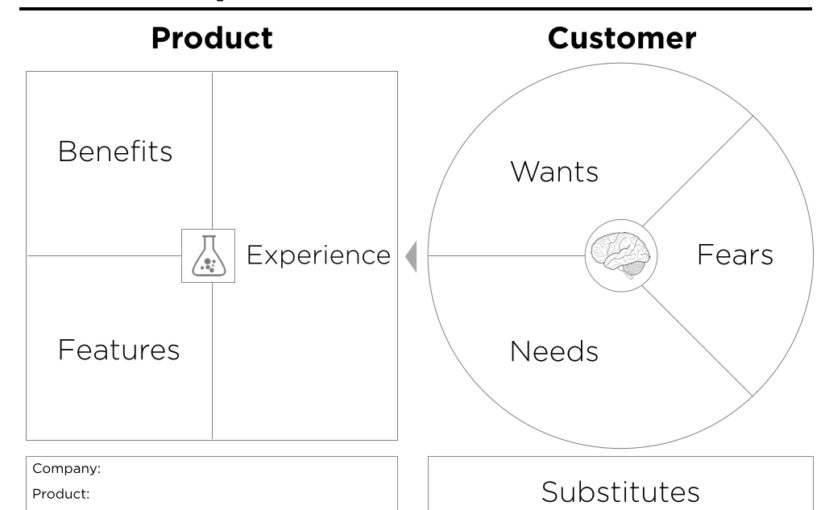
Benefits and fears are the core parts of the product. These are things that will either attract a customer to the product or drive them away due to the fact that these two pieces make the product what it is. In relations to the Market Share Simulation, a benefit of Allround is that it allows people to feel good by providing a good night's rest when sick. Features and needs are tangible parts of the product. They are what makes up the actual product.. Additionally, they are the parts of the product that are deemed necessary for the product. Again relating to the simulation, Alcohol is a feature of the drug. Finally, Experience and Wants are augmented parts of the product. They are additional services or attractions to a product that make someone choose that product over a competitors. Experience for Allround is the fact that the company has the highest customer satisfaction rating on the market.
A third concept discussed in the videos is the Product Mix. The main concept behind the Product Mix is that a company must have a variety of products in order to target a large amount of customers. A car company should as Toyota will produce cars, trucks, SUVs, as well as niche products in order to target a large portion of the population. While each product is designed for a target market, the company is large enough to target multiple markets. In each category (for Toyota it is cars, trucks, SUVs) the target market is the same. For cars, Toyota has a range of options including Corolla, Avalon, Camry, and Prius. Additionally, the more depth in each category meant more products in an individual market. The wider the mix is, the more people the company cater's to. So if Toyota were to spread into the motorcycle market, the Product Mix would broaden to now cater additionally to motorcycle enthusiasts.
One thing I would like to know more about is how a company decides to use either Sustainable Competitive Advantage or Alternative Competitive Advantage when trying to create value.
Dan Cushing
2/25/2018
In week 6 we learned about methods to determine the best way to allocate resources to maximize profit on a per product basis. The Boston Consulting Group (BCG) created a portfolio analysis to categorize products into four potential places. The placement of the product depends on both market growth and market share of that particular product and market. For a high market growth and high market share product, the product is placed in the Star category. This means that it is a very successful product that the company should continue to attempt to maximize revenue on. Next is low market growth but high market share. This product is known as a Cash Cow which means that although there is low potential for growth, the product is dominating the market share. The company here should continue to pump money into the product for as long as possible. A perfect example of this would be the Coca Cola product Coke. The market is dominated by Coke and Pepsi and there is very low market growth potential yet Coca Cola makes hundreds of millions off of their product. The next category is a product in low market share and low market growth. These products are known as Dogs and the product will simply not make a great deal of money. The final category is the Question Mark category. There is high market growth and low market share in this category. Tn this category additional research to determine what category it will transfer to. In our Smart Projects, my team Hydro Fit wants the product to become a star rather than a dog.
Another method we learned targeted a product versus a competitor's product. This is called the Value Proposition Canvas.
Benefits and fears are the core parts of the product. These are things that will either attract a customer to the product or drive them away due to the fact that these two pieces make the product what it is. In relations to the Market Share Simulation, a benefit of Allround is that it allows people to feel good by providing a good night's rest when sick. Features and needs are tangible parts of the product. They are what makes up the actual product.. Additionally, they are the parts of the product that are deemed necessary for the product. Again relating to the simulation, Alcohol is a feature of the drug. Finally, Experience and Wants are augmented parts of the product. They are additional services or attractions to a product that make someone choose that product over a competitors. Experience for Allround is the fact that the company has the highest customer satisfaction rating on the market.
A third concept discussed in the videos is the Product Mix. The main concept behind the Product Mix is that a company must have a variety of products in order to target a large amount of customers. A car company should as Toyota will produce cars, trucks, SUVs, as well as niche products in order to target a large portion of the population. While each product is designed for a target market, the company is large enough to target multiple markets. In each category (for Toyota it is cars, trucks, SUVs) the target market is the same. For cars, Toyota has a range of options including Corolla, Avalon, Camry, and Prius. Additionally, the more depth in each category meant more products in an individual market. The wider the mix is, the more people the company cater's to. So if Toyota were to spread into the motorcycle market, the Product Mix would broaden to now cater additionally to motorcycle enthusiasts.
One thing I would like to know more about is how a company decides to use either Sustainable Competitive Advantage or Alternative Competitive Advantage when trying to create value.

Comments
Post a Comment